
Delivery to the home with a customer signature.
This method leads to lots of failed delivery, the source of most greenhouse gas emissions involved in last-mile delivery. This can be minimized by scheduling ahead, but this makes shipping routing complicated and often in Small trucks, vans, or cars with few packages are significantly less carbon efficient than big trucks (or especially trains) with many packages.
Delivery to the home irregardless of signature.
Much more efficient than attended home delivery due to the lack of delivery windows, but still requires going to individual homes.
The high risk of stolen packages leads not only to frustrated customers and lost revenue, but also an environmental impact as those lost packages have to be replaced. Replacing packages essentially doubles the environmental impact of the delivery (product, packaging, shipping, etc). Routes also have to be diverted - often out of the way - to pick up returns.
A box to drop off packages where the customer can pick up the package when they are available.
There are two variants:
The box is at the customer's location.
Inefficient delivery with lots of stops due to delivery points at individual houses. However, avoids needing to make a second delivery attempt. Also helps to cut down on stolen packages due to the added security and privacy of a reception box.
An insulated and secured box to deliver to at some specified location.
The location is chosen to optimize some of the inefficiency issues of the own reception box method, while still remaining relatively close to the customer. However, because these more central delivery boxes may not be at a protected residential or commercial address, there is a risk of the box or the items inside being stolen if not secured properly.
A point where the package recipient can pick up packages.
These are more efficient and environmentally conscious than individual reception boxes or home delivery, as the consumer is responsible almost in part for part of that last mile journey. However, depending on the distribution of people, there can still be a lot of locations required.
There are two common variants: locker point and service point:
A shared reception box installed at a public area.
Requires building the point for the locker. This can be environmentally and economically costly as there is a lot of security that has to go into a well engineered location.
Provides the same function as a locker point, but exists in an already existing location such as schools, local stores, hospitals, etc. This significantly reduces the environmental impact compared to locker points (no new buildings), and drastically compared to delivery boxes (less locations).
A post office can be set as a first time delivery location. However, their most common use right now is as a failed first-time delivery destination.
Delivering to the post office for initial delivery can vastly minimize last mile delivery cost in multiple ways, as it centralizes the locations where people pay, collect, and most importantly return items. Also, if a return is needed, it can be sent out from the same location, not requiring any other shuffling via local transportation vehicles.
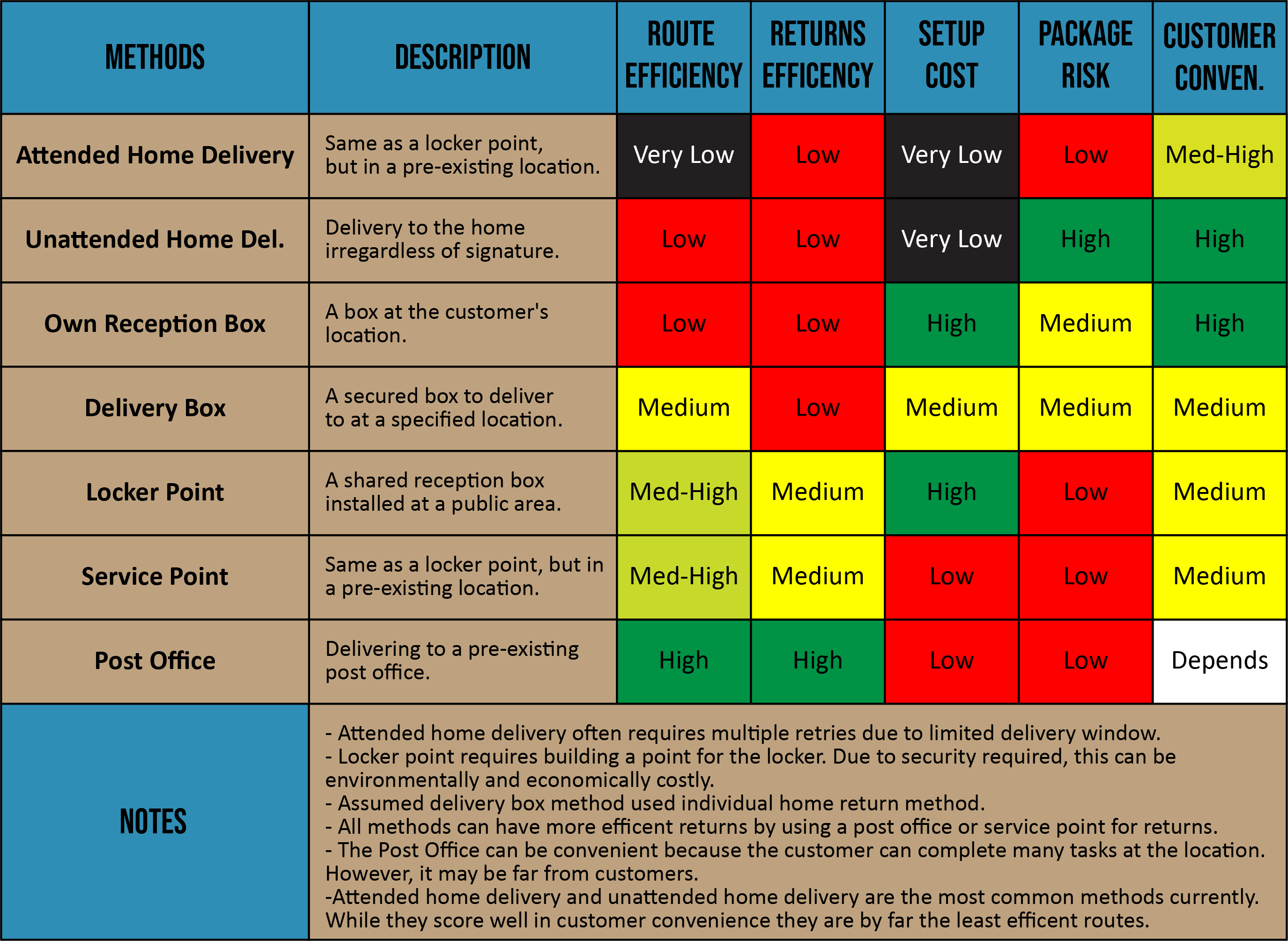
Comparison and summary of the strengths and weaknesses of various last mile delivery methods.
The two most common methods currently are both home delivery methods: attended home delivery and unattended home delivery (described above). The home delivery methods (attended home delivery and unattended home delivery) are the most common methods currently used, but are also the most costly. This is especially true for attended home delivery, which was the most common until recent years.
These choices look even worse environmentally when accounting for returns, which essentially doubles their negative environmental impact due to the inconvenience of having to stop at individual locations.
Amazon has made recent moves to motivate customers to drop off returns at a centralized point, such as the USPS or an Amazon locker. However, this appears to mostly be motivated by profits rather than by environmental impact. Nonetheless, this is more environmentally friendly than to house returns. But more steps need to be made.
In the future, there should be more consideration of environmental impact when considering last mile delivery methods. This is especially true because the environmental benefits mostly coincide with the economic benefits. Right now, the e-commerce culture has prioritized customer convenience over cost saving or environmental impact. There could definitely be more education and consumer enabled choice around these issues.
Changing last mile shipping methods can have a drastic, quick effect on emissions for shipping. It is one of the most costly parts of shipping and is such a huge part of modern day life. Methods to look at moving towards should reduce the number of delivery points, feature more local delivery, less costly returns, and help with optimizing route efficiency.